SMM panel ROI is the return on what you spend on an SMM panel: the revenue you can trace back to your orders, set against what those orders cost you. The formula is simple. The hard part is filling in its two terms honestly, because a panel order shows up on your balance the same day, while any revenue arrives later, through other people, and only if you can tie it back.
We run a panel, Boostero, so this guide is written from the seller's side. We can tell you what belongs on the panel's part of the cost side, because our refund policy and our prices decide it. We cannot tell you the revenue side: we have no record of what our customers earn after an order, so that half is yours to measure, and this guide shows how.
The SMM Panel ROI Formula
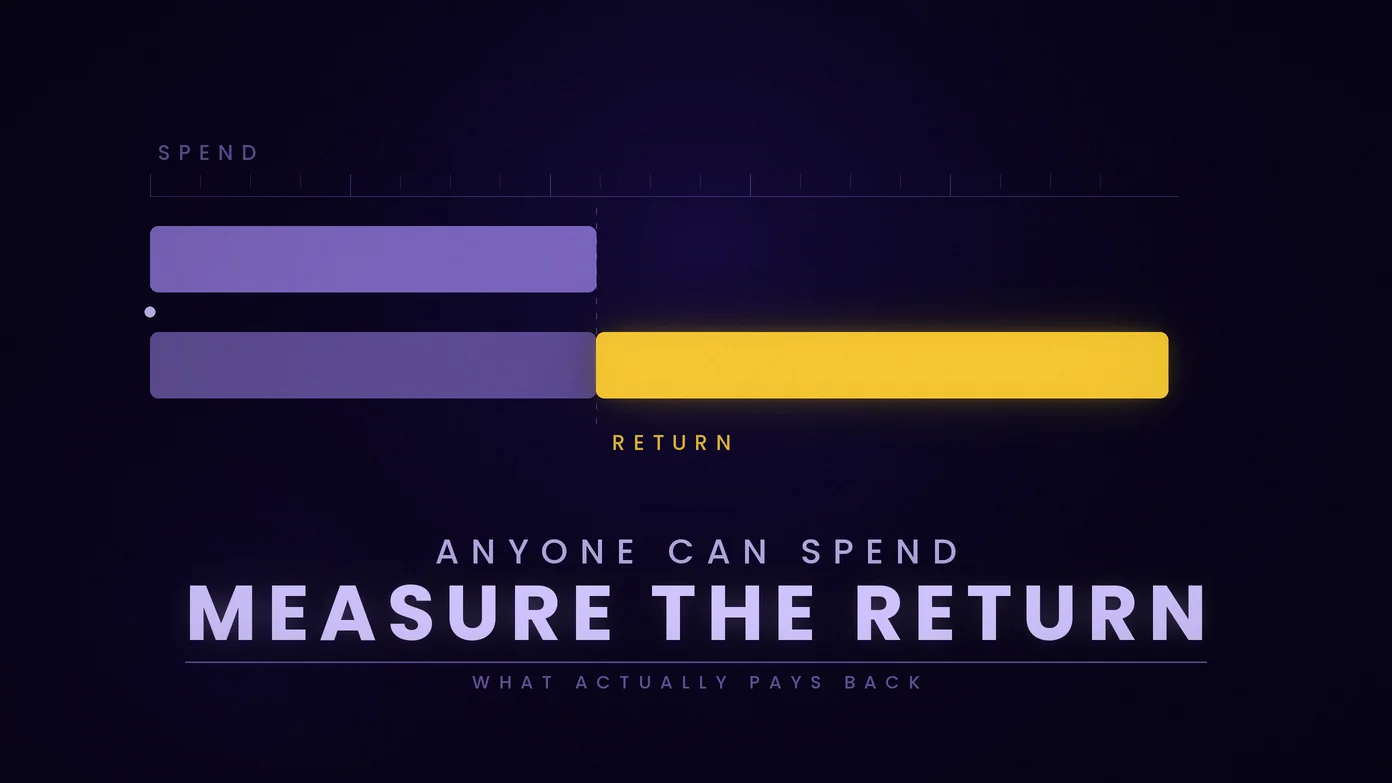
SMM panel ROI compares the revenue you can attribute to your orders with what those orders cost. The basic formula is: (Revenue Generated - Investment Cost) / Investment Cost x 100. The result is a percentage: above zero, the revenue you can attribute was larger than the cost; below zero, it was smaller.
A worked example, only to show the arithmetic: if the revenue you can attribute to a month of orders is $600 and those orders cost you $400, the ROI is (600 - 400) / 400 x 100 = 50 percent; if the revenue you can attribute is $300 against the same $400, it is (300 - 400) / 400 x 100 = -25 percent. These numbers are not a result anyone measured. Your own figures go in their place, and the rest of this guide is about getting each one right.
What Counts as Investment Cost on a Panel
The cost in the formula is what you were charged for the orders in the period you are measuring, less what came back. On Boostero, our refund policy decides what comes back, and these are the parts that move the number:
- The charge, not the deposit: money you add to your balance is not spent until an order uses it, and the balance does not expire. Count the orders, not the top-ups.
- Refunds to your balance: if an order cannot be delivered in full, the part that was not delivered is refunded to your balance, and if the supplier cancels an order, the full amount goes back. Within 14 days of placing an order, you can also ask for a refund of the undelivered part if it is marked Completed but was not fully delivered, or of the full amount if it has not started within 5 days. Whatever came back is subtracted from the cost.
- Bonus money: if part of an order was paid from a bonus added to your balance, for example from a coupon or a promotion, that part was not money you paid. If orders used it, leave that part out of the cost.
- What does not come back: an order delivered to the link you entered, even the wrong one; an order placed while another order for the same link and metric was running; a drop on a service that states No Refill; and orders affected by actions a platform takes against the account or content. Those stay in the cost.
Two things do not need adjusting by hand. The rate per 1,000 is the same at every order size, so a larger order does not lower the rate. And the loyalty level discount, from 3 percent at $500 of lifetime spend up to 15 percent at $20,000, applies automatically to every order, so it is already in what you were charged; subtracting it again would count it twice. Prices per 1,000 differ between panels, and so do the refund terms that decide what comes back, so when you compare panels, compare both. Our comparison of Boostero with three other panels sets them side by side, each read on the date it gives.
Then add what the panel line leaves out: the hours spent on content, design and replies, and any other tool you paid for in the same period. An ROI that counts the panel and not the work behind it looks better than it is.
What Counts as Revenue, and How to Tie It to an Order
Revenue in the formula means money from people who bought: sales, paid sign-ups, bookings. Our terms state that delivered followers, likes or views are not expected to interact with your content, so an order is not itself a source of revenue, and a higher count is not revenue either. What you can measure is whether the people who came to your profile or site in the period went on to buy, and whether that changed after the order. It only shows up if you track it.
Three ways to track it:
- Tagged links: put campaign parameters on the links in your profiles and posts. As Google Analytics' help page on URL builders put it when we read it on 29 October 2026, "When a user clicks a referral link, the URL parameters are sent to Analytics, and the parameter values are visible in the Traffic acquisition report." On 29 October 2026 the same page also recommended one utm_source for each platform, so Instagram and TikTok traffic stay apart.
- A baseline: write down your weekly visits, sign-ups and sales before you order, then measure the same weeks after, over a period you choose in advance, leaving out any traffic you ordered, since bought visits are not buyers. Change one thing at a time; if you also launched a product or ran an ad, a before and after comparison cannot tell you which one did it.
- Order dates: our dashboard shows each order's status, the date it was placed, the start count and what remains. Line those dates up with your analytics, so a change you see can be checked against when each order was placed. Our guide to SMM reporting covers what a full order record should contain.
Metrics Between the Order and the Revenue
To read SMM panel campaigns between the order and any sale, four metrics help, each measured on your own account rather than taken from a benchmark:
- Conversion rate: the share of visitors who buy or sign up. Compare your own rate before and after, from the same analytics, over periods of the same length.
- Cost per acquisition (CPA): the investment cost divided by the new customers you can attribute to the period. If you can attribute none, the CPA cannot be calculated, and that is worth knowing too.
- Customer lifetime value (CLV): if customers buy again, their later purchases can belong in the revenue term, but only the ones you can trace to the same source.
- Revenue attribution: the rule under all three. Revenue you cannot tie to a tagged link or a measured change against your baseline stays out of the formula.
Our guide to an SMM panel for small business covers setting the budget itself; this one covers what that budget returned.
Where the Services Are
The services themselves, each with the terms that apply to it, including quality grade and refill coverage, stated before you order, are on our platform pages: the SMM panel for Instagram, the Facebook SMM panel, the TikTok SMM panel and the YouTube SMM panel. If you resell orders to your own clients, the revenue term is what your clients pay you, and our SMM reseller panel page covers how reselling works on Boostero.
Common ROI Mistakes to Avoid
- Counting deposits instead of the orders that used them.
- Forgetting refunds that came back to the balance, or counting them twice.
- Treating likes, views or followers as revenue: a count is not a sale.
- Measuring without a baseline, or changing several things at once.
- Leaving your own time and other tools out of the cost.
Get the two terms right and the formula is the easy part: a cost you can check against your order list and refunds, and a revenue figure you can trace to its source.
Frequently Asked Questions
What is ROI in SMM panels?
ROI in SMM panels is the return on what you spend on a panel: the revenue you can attribute to your orders, minus what the orders cost you, divided by that cost. On a panel, the cost is what you were charged less refunds to your balance; the revenue has to be traced through your own analytics.
How do you calculate SMM panel ROI?
Use the formula (Revenue Generated - Investment Cost) / Investment Cost x 100. For the cost, count the orders in the period, not your deposits, subtract anything refunded to your balance, and add your time and other tools. For the revenue, count only sales you can tie to a tagged link or to a change against a baseline you measured before ordering.
What is considered good ROI for social media marketing?
There is no figure that holds for every business, and we have no record of what our customers earn after an order. An ROI above zero means the revenue you could attribute was larger than the cost. Whether that is good depends on your margins and on what else the same money could have done.
Are SMM panels legal and safe for ROI?
That depends on where you operate and how you use the service, and it is a legal question we cannot answer for you. Rules differ by country, so check what applies to you before ordering. Each platform sets its own rules, so no panel can promise how a platform will treat an account.
How long does it take to see ROI from SMM panels?
Most services state when an order is expected to start: on 20 October 2026, 1,547 of the 1,655 services in our public list stated an estimated start window. Revenue has no timetable we can give you. Decide the measuring period before you order, use the same length before and after, and read the result at the end of it.