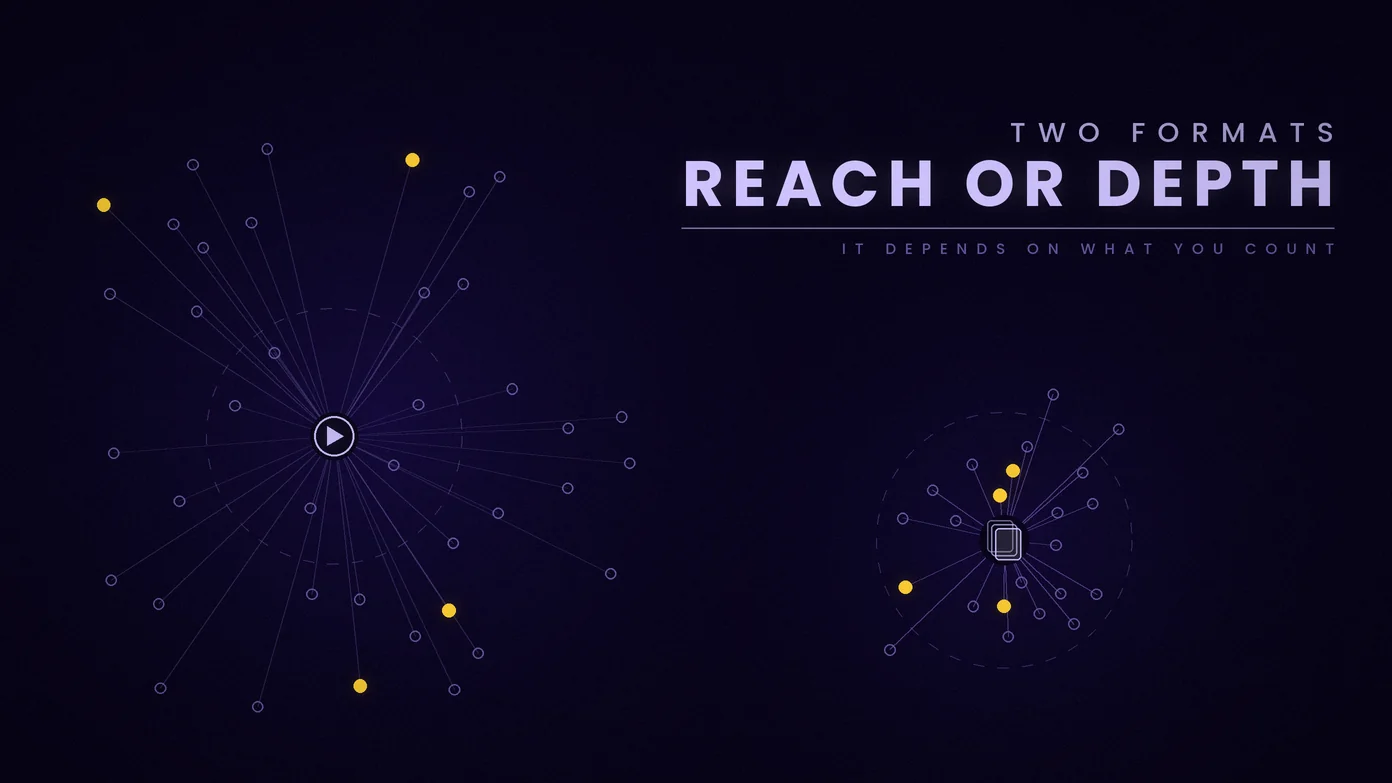
A reel is the format Instagram builds for discovery. In Instagram's 2023 explanation of its ranking, most of what people see in Reels comes from accounts they do not follow, while the feed mixes the accounts people follow with recommendations from accounts they do not. A post, meaning a single photo or a carousel of several, is built for that feed.
The large studies agree on less than their headlines suggest. Reels reach more accounts in two of them, and on smaller pages in a third; on brand pages above 50,000 followers, that third study found carousels with a higher reach rate, reach divided by follower count, than reels. After the first look, carousels lead on views, saves and interactions per account reached in most of the data, while on Socialinsider's brand pages reels draw more comments. This guide shows what each study counted, how to read the same numbers for your own account, and what our order data adds.
The Short Answer
Post a reel when the job is to be found by people who do not follow you yet, above all on an account under 50,000 followers. Post a carousel when the job is to be saved and viewed again by the people who already follow you. On a large account, do not assume the reel wins reach: test both. A single photo reaches the fewest accounts in nearly all of the data, and it still has its place when one image says everything.
Reel or Post: What Each One Is in 2026
Since 2022 the line has been simple. On 21 July 2022 Instagram announced that new video posts shorter than 15 minutes would be shared as reels, and that videos posted before the change would stay videos. So a single video under 15 minutes that you post today is a reel. Instagram's help center now says a reel can run to 20 minutes, and that reels over 3 minutes will not be recommended to new audiences.
A post is the rest of the feed: a single photo, or a carousel, which holds several photos or videos that the viewer swipes through. When people ask "reel or post?", the choice in practice is between a short video and a photo or carousel, so that is the comparison below.
Where Instagram Shows Each One
Instagram does not run one algorithm. In the same explanation, each part of the app, from Feed and Stories to Explore, Reels and Search, uses its own. In Feed, the five interactions Instagram looks at most closely are how likely you are to spend a few seconds on a post, comment on it, like it, share it and tap the profile photo. In Reels, the most important predictions are how likely you are to reshare a reel, watch it all the way through, like it and go to its audio page. In Feed, format is a signal too: if Instagram notices that you prefer photos, it shows you more photos.
So a reel is built to be judged by people who do not follow you yet, and a post first by the people who chose to follow you. Neither is the better format. They are built for two different jobs, and the studies below measure those jobs in different ways.
What the Studies Measured
Each report below states what it counted, and the table gives its sample and period where the report publishes them. What each one counted, more than its size, explains why they disagree.
| Report, sample and period | What it counted | Result |
|---|---|---|
| Buffer, more than 4 million posts sent through Buffer, January 2022 to October 2024 | Reach per post | Reels reached 1.36 times as many accounts as carousels and 2.25 times as many as single photos |
| Buffer, the same posts | Interactions per post | Carousels drew 1.12 times the interactions of reels and 2.14 times those of single photos |
| Buffer, 2026 format analysis, published 19 March 2026, from more than 45 million posts across platforms; the Instagram sample and period are not stated | Median interactions as a share of accounts reached | Carousels 6.9%, single images 4.4%, reels 3.3% |
| Metricool and HypeAuditor, 700 million posts from 28 million influencer accounts, January to June 2025 | Median reach, likes and comments in six follower tiers | Reels led reach in every tier; from 500,000 followers up, carousels increasingly won on likes and comments |
| Socialinsider, reels study, 140,000 reels from business pages, January to June 2026 | Reach divided by follower count, on pages of 1,000 to 1 million followers | Reels led on pages under 50,000 followers, carousels above that size |
| Socialinsider, reach study, 872,075 Facebook and Instagram posts from brand pages, January 2025 to August 2026 | Reach divided by follower count, all page sizes | Carousels 4.50%, reels 4.10%, images 4.00% |
| Socialinsider, 2026 benchmarks, 35 million posts from 447,613 brand pages, 2025 | Likes and comments divided by follower count; average views, saves and comments per post | Carousels 0.55%, reels 0.52%, images 0.37%; carousels led average views and reels led comments at every page size |
| Metricool, 2026 Instagram study, more than 24.3 million posts from 375,118 accounts, January and February 2026 against the same months of 2025 | Change year on year, and saves | Single images lost 21.96% of their reach; carousels drew nine times the saves of single images |
Reach: Reels Lead on Smaller Accounts, Not Everywhere
Buffer's analysis of more than 4 million posts sent through its tool between January 2022 and October 2024 found reels reaching 1.36 times as many accounts as carousels and 2.25 times as many as single photos, and Buffer reads that as the work of the Reels feed, which shows a reel to more people who do not follow the account. The 2025 playbook from Metricool and HypeAuditor, built on 700 million posts from 28 million influencer accounts, found reels leading reach in every follower tier it measured.
Socialinsider's data on brand pages says something narrower. In its 2026 reels study, reels had the highest reach rate, reach divided by follower count, on pages under 50,000 followers: 9.78% against 8.80% for carousels on pages with 1,000 to 5,000 followers, while carousels led above that size, 6.00% against 5.00% on pages with 100,000 to 1 million. Across all page sizes, its September 2026 reach study put the reach of carousels at 4.50% of follower count, reels at 4.10% and images at 4.00%.
So "reels get more reach" holds for smaller accounts in both datasets that compare formats' reach by account size, and in Buffer's data overall. It is not a law: on Socialinsider's brand pages above 50,000 followers, it reverses.
After the First Look: Views, Saves and Interactions
On interactions, Buffer's 2022 to 2024 analysis found carousels drawing 1.12 times the likes, comments, saves and shares of reels. Buffer's 2026 format analysis divides interactions by the number of accounts reached and puts carousels further ahead: the median carousel drew interactions equal to 6.9% of the accounts it reached, a single image 4.4% and a reel 3.3%. Socialinsider's 2026 benchmarks, which divide likes and comments by followers instead, found carousels and reels much closer in 2025: carousels 0.55%, reels 0.52% and images 0.37%.
Views and saves lean toward carousels too. In Socialinsider's 2025 data on brand pages, carousels averaged more views per post than reels at every page size it reports, 35,370 against 16,035 on pages with 100,000 to 1 million followers, and matched or beat reels on saves, 98 against 96 per post at the same size. Metricool's 2026 Instagram study, covering more than 24.3 million posts from 375,118 accounts, found carousels drawing nine times the saves of single-image posts.
Comments run the other way. In Socialinsider's 2025 data on brand pages, reels drew more comments per post than carousels at every page size, 60 against 40 on pages with 100,000 to 1 million followers, though among influencer accounts of 500,000 followers and up, the Metricool and HypeAuditor playbook found carousels increasingly winning on likes and comments. Metricool's 2026 study calls reels Instagram's strongest format for discovery and interaction, with more than four times the interactions of single-image posts.
The single image trails on most counts. Metricool found its reach down 21.96%, its interactions down 25.41% and its engagement down 45.98% in January and February 2026 against the same months of 2025. There are exceptions worth knowing. Per account reached, Buffer's 2026 data has a single image drawing more interactions than a reel, 4.4% against 3.3%: it reaches fewer accounts, and a larger share of them act. And in Socialinsider's 2025 data, single images averaged more views per post than reels at three of the five page sizes it reports.
Why Careful Studies Disagree
Three things separate these results, and none of them makes any study wrong.
- What they count: Instagram counts a view each time content is played or displayed, and a viewer once per account. Socialinsider explains its view figures by the carousel's habit of coming back: a carousel someone scrolled past can be shown again with a different slide. Reach counts that person once.
- What they divide by: a reel's reach takes in more people who do not follow the account, so interactions divided by reach fall even when interactions per post hold up. Divided by followers, as Socialinsider does it, reels and carousels sit within a few hundredths of a percentage point of each other.
- Whose posts they sampled: posts sent through Buffer, the influencer accounts in the Metricool and HypeAuditor dataset and Socialinsider's brand pages are different populations, and Socialinsider's own table shows the answer on reach turning at 50,000 followers.
Read one number alone and you get a clean winner. Read them together and you get the more useful answer: the format that wins depends on the number you need and on the size of the account it is measured on.
How to Choose
Start from the job, then from the size of the account.
- To reach people who do not follow you yet: post a reel, especially on an account under 50,000 followers, where both studies that compare formats' reach by account size have reels ahead. Keep it under 3 minutes, since longer reels are not recommended to new audiences. In Socialinsider's 2026 reels study, reels of 30 to 60 seconds had the highest reach rate, reach equal to 5.60% of follower count, against 3.50% for reels over two minutes.
- To start a conversation on a brand page: post a reel. In Socialinsider's 2025 data on brand pages, reels drew more comments per post than carousels at every page size.
- To be saved and viewed again: post a carousel. It leads views and matches or beats reels on saves in Socialinsider's data.
- On a large account: do not assume the reel wins reach. On brand pages above 50,000 followers, Socialinsider found carousels with a higher reach rate, reach divided by follower count, than reels, so test both on your own account before you plan around either.
- For one strong image: a single photo is fine when one frame says everything. Expect it to reach the fewest accounts.
- To try a reel on strangers first: trial reels are shown to accounts that do not follow you, and you can share one with your followers at any time. They need a public account with at least 200 followers on a professional account, or 1,000 on a personal one.
Plan for both: reels to be found, and posts to be kept. When you post matters as well, and our guide to the best time to post on Instagram covers the hour.
How to Read Your Own Numbers
Instagram's insights keep apart the counts these studies use. Views are the number of times your content was played or displayed; viewers are the number of unique accounts that saw it on screen at least once. Interactions count actions such as likes, comments, saves and shares, and accounts engaged counts the unique accounts behind them. For posts, stories and live videos, accounts engaged can be broken down into followers and non-followers.
For reels, the reel insights add watch time, average watch time and follows, the accounts that started following you as a result of viewing the reel. So judge each format by its own job: a reel by its viewers, follows and comments, and a carousel by its interactions and saves per viewer, over several posts of each, before you decide which format your account should lean on.
What Our Order Data Adds
Boostero is an SMM panel, and our records show which kind of Instagram link each order carried. In the order data behind our State of Social Media Growth 2026 study, Instagram views orders placed between January 2025 and June 2026 carried at least three links to a reel for every link to a feed post, whether counted by order, with each account counted once, without the largest account or without the ten largest. A link counted as a reel when its address held /reel/ or /reels/, and as a post when it held /p/; links of any other kind are left out of the ratio.
So in each of those four counts, most of our customers' Instagram views orders carried a reel link. That is a fact about our customers' orders, not a ranking of formats: our records say nothing about how a reel or a post performs once an order is filled. Our Instagram views services take a link to a reel or a video post, and each service states the terms that apply to it, including quality grade and refill coverage, before you order. Who the reel reaches from there, and who acts on it, is Instagram's call, not ours.
Putting It Together
A reel is how an account gets found; a carousel is how it holds the people it already has. On a smaller account, lean on reels to be found and on carousels to be kept. On a large one, test carousels for reach as well. Whatever the mix, read your own viewers, follows, saves and interactions, because the studies above describe their samples, not your audience.
Frequently Asked Questions
Is it better to post a video or a reel on Instagram?
For a single video under 15 minutes there is no longer a choice. Since a change Instagram announced in July 2022, new video posts shorter than 15 minutes are shared as reels. A reel can now run to 20 minutes, but reels over 3 minutes are not recommended to new audiences, so keep a video meant for discovery under that line.
Do posts get more views than reels?
Often, if you count views. In Socialinsider's 2025 data on brand pages, carousels averaged more views per post than reels at every page size it reports. Views count every time a post is played or displayed, though, and in Buffer's 2022 to 2024 data reels reached more unique accounts, 1.36 times as many as carousels.
Do reels get more reach than posts?
On smaller accounts, yes. Socialinsider's 2026 reels study found reels with the highest reach rate, reach divided by follower count, on pages under 50,000 followers, and carousels ahead above that size; Buffer's data and the Metricool and HypeAuditor playbook have reels ahead overall. Across all page sizes, Socialinsider's September 2026 reach study put carousels slightly ahead, with reach equal to 4.50% of follower count against 4.10% for reels.
What are the disadvantages of reels?
In Buffer's 2026 data, a smaller share of the people a reel reaches act on it: the median reel drew interactions equal to 3.3% of the accounts it reached, against 6.9% for a carousel. In Socialinsider's 2025 data on brand pages, carousels led on views and matched or beat reels on saves. Reels over 3 minutes are also not recommended to new audiences.
Should a small account post reels or carousels?
Both: reels to be found, and carousels to be kept. On accounts under 50,000 followers, the two studies that compare formats' reach by account size have reels ahead, and Socialinsider's 2025 data has carousels matching or beating reels on saves at those sizes, while reels drew more comments. Buffer's 2026 analysis, which does not split by account size, has carousels ahead on interactions per account reached. Compare reels by viewers, follows and comments, and carousels by saves and interactions per viewer.