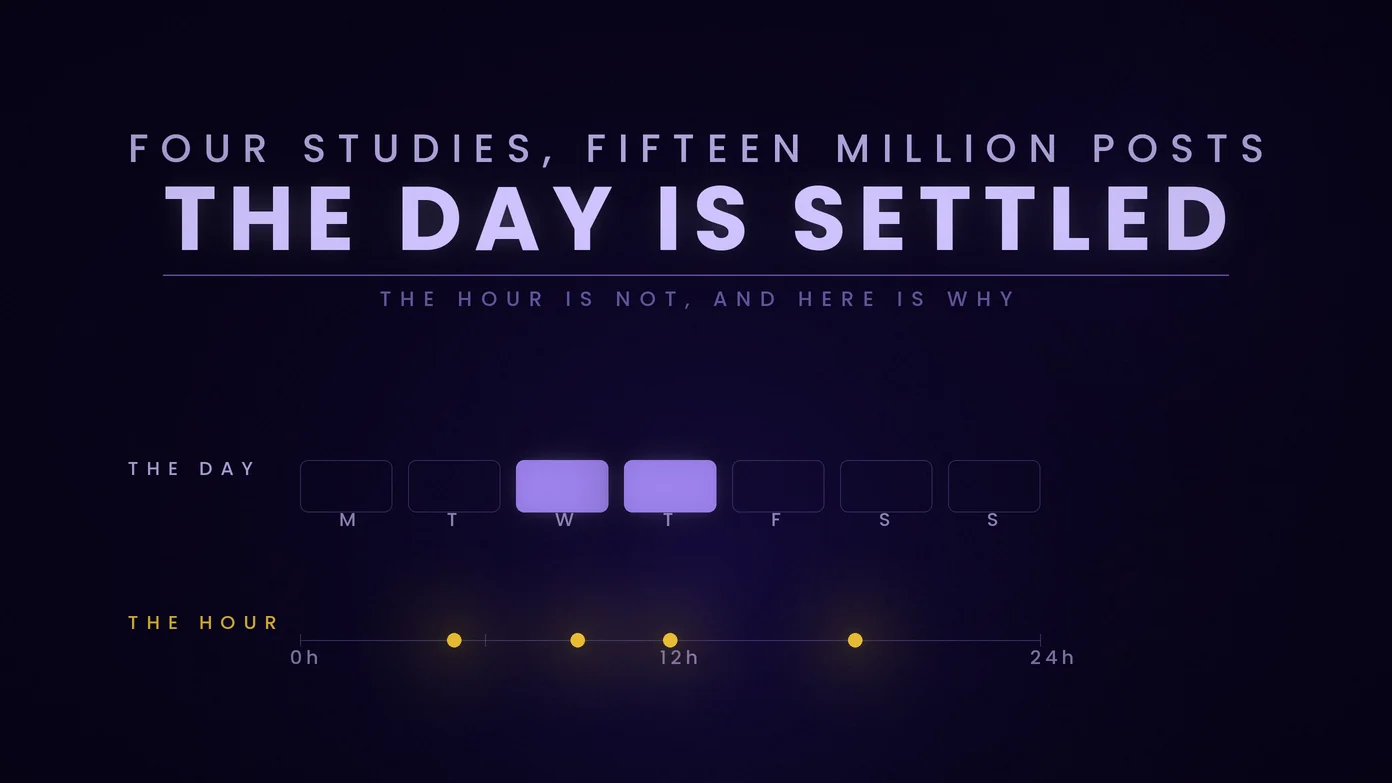
Four large studies published in 2026 asked when to post on Instagram, and between them they measured more than fifteen million posts. They agree on the day. They disagree on the hour, and not by a little: Later's best time is 5am, while Buffer's top three slots run to 6pm, thirteen hours later. Most articles on this question pick one study and present its hour as the answer. This one explains which half of the question is settled, which half is not, and what to do about each.
At the end there is a section from our own order data, which answers a neighbouring question rather than this one and is labelled as such.
The Short Answer
Post midweek. Buffer, Sprout Social and Hootsuite each put at least two of their strongest days between Tuesday and Thursday, and the two that rank the weakest days both put Saturday at or near the bottom. That part you can act on today.
The hour is contested, and the honest range is wide: mid-morning to early evening in your audience's local time, with one credible study pointing at dawn. The next two sections explain why, and the section after that tells you how to replace the range with your own number.
What the Studies Agree On: The Day
Buffer analysed 9.6 million Instagram posts from over 200,000 accounts and ranks Wednesday first, then Thursday, then Tuesday, with Friday and Saturday at the bottom.
Sprout Social analysed close to 2 billion engagements across roughly 307,000 profiles and finds Tuesday and Wednesday strongest, with weekends lowest overall and across almost every industry.
Hootsuite, on over a million posts across 118 countries, ranks Monday, Tuesday and Thursday strongest.
SocialPilot, on 7 million posts from about 50,000 accounts, ranks Tuesday and Wednesday first with Thursday close behind.
Every one of these studies puts midweek days among its strongest and no weekend day among them. That is as close to settled as this kind of question gets.
What They Disagree On: The Hour
Here the same studies split, and the split is the useful part.
- Buffer names Thursday 9am, Wednesday 12pm and Wednesday 6pm as its top three slots, and finds evenings beat mornings on most days.
- Sprout Social points to midday through evening, roughly noon to 7pm.
- Later, on more than six million posts plus a separate analysis of 975,000 Reels, points much earlier: around 5am, and for Reels specifically, midnight to 6am on Mondays.
- SocialPilot favours early mornings, 7am to 8am.
Later's 5am and Buffer's 6pm are thirteen hours apart. Both studies measured millions of real posts. Neither is wrong.
Why Four Careful Studies Give Four Hours
The disagreement is not noise. It comes from two choices each study made differently, and once you see them the hours stop contradicting each other.
- What counts as engagement. Later and Buffer measure engagement rate per post. Sprout counts total engagements. A post at 5am reaches a small, attentive audience with almost no competition in the feed, which produces a high rate on a low total. A post at 6pm reaches more people and competes with more posts, which produces a high total on a lower rate. Which one is "best" depends on which one you are optimising, and the studies chose differently.
- Whose posts. Buffer samples posts scheduled through Buffer. Sprout samples its customers' profiles, which lean toward brands and agencies. Later samples its own users, who skew toward creators. Brands post in office hours and creators do not, so each dataset finds peaks partly where its own users already post.
So the day is settled because both choices point the same way on it. The hour is not because they pull apart. An aggregate hour is a starting point for your test, not a number to schedule around.
How to Find Your Own Hour
Instagram already has the answer for your account, and it is more reliable than any published average because it measures your followers rather than someone else's.
- Open Instagram Insights, go to Total followers, and read Most active times. It shows the hours and days your followers are on the app.
- Check top locations in the same view. If your audience spans time zones, one posting time cannot serve all of them and you are choosing which group to serve first.
- Pick a slot from your own active-times chart, post there for two weeks with everything else held steady, and compare reach and saves against your previous two weeks. One variable at a time.
- Repeat with a second slot. The gap between your two results tells you how much timing matters for your account, which is the number no study can give you.
What Timing Can and Cannot Do
Timing decides who sees a post in its first hour, and the first hour affects whether Instagram tries it on a wider audience. Buffer's report notes that the algorithm now weights sends per reach, how often a post is forwarded to a friend, as a strong ranking signal, and that signal accumulates fastest when the people most likely to send are online.
What timing cannot do is make a post worth sending. A well-timed post that nobody saves has been shown to more people who scrolled past it. Timing buys the first hour. The content decides what happens in it.
A Different Question: When People Order Engagement, and Whether It Matters
This section is our own data and it answers a neighbouring question. The studies above measure when posts are published. We can measure when engagement is ordered, and whether the time of ordering changes what happens to the order.
The figures come from 543,708 Instagram orders placed between January 2025 and June 2026, after excluding four bulk accounts. That exclusion is large, those four accounts placed most of the Instagram orders in the period, and it is stated here rather than hidden because without it the curve is theirs and not a picture of individual buyers. All times are UTC, because our order records do not carry buyer country. An afternoon peak in UTC across a global customer base is the sum of several local afternoons and evenings, so it describes our order flow rather than any one country's habits.
Orders cluster in the same window as TikTok
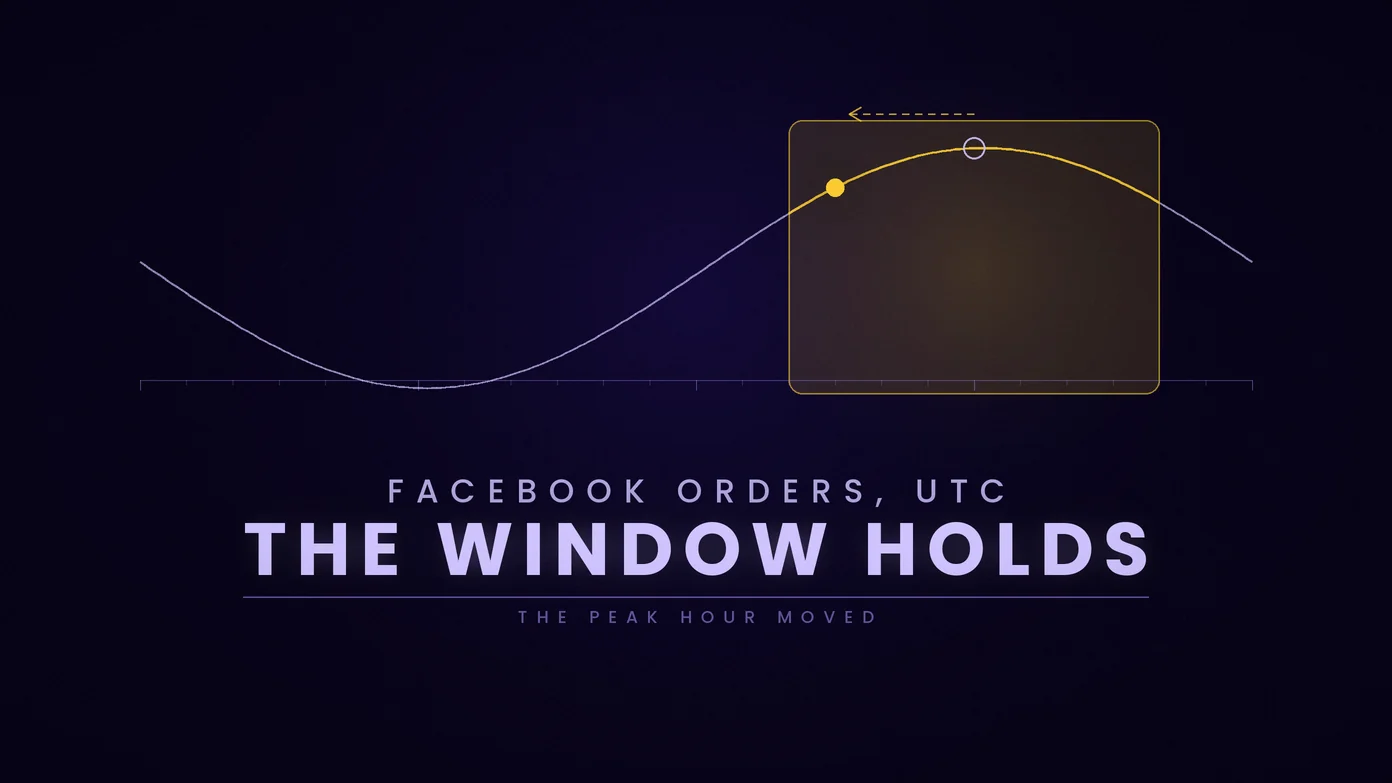
Counted by order, ordering runs 1.75 times higher at its busiest hour than at its quietest, a gap that holds under every count we ran, and the block from 14:00 to 23:00 UTC sits above the daily average whether we count every order, each account once, or leave out the largest accounts. That is the same shape we measured for TikTok, to within the noise between alternate days, and it is worth saying because it means the people ordering Instagram and TikTok engagement are largely the same people on the same schedule, not two audiences.
By day of week the spread is narrow: counted by order, Tuesday takes 15.4 percent of orders and Sunday 12.9 percent, a ratio of 1.19 that holds under every count we ran.
Delivery does not vary by hour, and that is the finding
For TikTok, counted by order, partial deliveries were 2.5 times as common in the busiest hour as in the quietest, a small edge for ordering off-peak; counted by account, the difference was too small to be sure of. We ran the same measurement on Instagram expecting the same result.
It is not there. Counted by order, the busiest hour and the quietest hour deliver at the same rate: a ratio of 1.07, with a range from 0.78 to 1.64 once accounts are allowed for, and 1.02 once the mix of services ordered in each hour is accounted for. By day of week it is 1.09 counted by order, with a range from 0.96 to 1.24 once accounts are allowed for, and 1.02 after the same adjustment.
So on Instagram the time you order makes no measurable difference to whether the order fills. There is no off-peak edge to give you, and we would rather say that than manufacture one. It is the one TikTok finding that does not carry over, and finding that a result does not replicate is as much a result as finding that it does.
What we cannot tell you
We have no retention figures by hour, and no buyer country, so no local-time curve and no US-only cut. The single busiest hour is also not something we would publish: the ten largest remaining accounts still carry nearly half of the orders, and removing them moves the busiest hour, counted by order, by three hours while leaving the window intact. The window is robust. The hour inside it is not, which is a smaller version of exactly what the four public studies ran into.
Putting It Together
Post midweek, between Tuesday and Thursday; the studies that rank days agree on that, and you do not need to test it. Start your hour somewhere between late morning and early evening in your audience's local time, because that is where Buffer's and Sprout Social's hours overlap, and treat Later's dawn slot as a legitimate second test rather than an outlier, since it is measuring something real about low competition.
Replace all of that with Instagram Insights the moment you have two weeks of it.
If you use a panel to give a post early momentum, our own numbers say the hour you order does not affect delivery on Instagram, so order when it suits your schedule. The Instagram panel covers likes, followers, views, story views and comments, with paced delivery and public links only.
The TikTok version of this post, with the delivery finding that did apply there, is here. The part of growth no schedule solves is in our guide to seven principles that last.
Frequently Asked Questions
What is the best day to post on Instagram?
Midweek. Buffer ranks Wednesday first, then Thursday and Tuesday; Sprout Social names Tuesday and Wednesday; Hootsuite names Monday, Tuesday and Thursday; SocialPilot names Tuesday and Wednesday, with Thursday close behind. Saturday sits at or near the bottom wherever a study ranks the weakest days. This is the settled half of the question.
What is the best hour to post on Instagram?
Contested. Buffer says Thursday 9am, Wednesday noon and Wednesday 6pm. Later says around 5am, and midnight to 6am on Mondays for Reels. SocialPilot says 7am to 8am. Sprout says midday to evening. They measure different things on different audiences, and the honest answer is a range plus a test on your own account.
Why does one study say 5am and another say midday to evening?
Because they measure different things. A post at 5am gets a high engagement rate from a small audience with no competition. A post in the afternoon or evening gets a high engagement total from a large audience with lots of competition. Later measures rate, Sprout measures total, and both are right about what they measured.
How do I find my own best time?
Instagram Insights, Total followers, Most active times. It shows when your followers are on the app. Test one slot from that chart for two weeks with everything else held steady, then a second slot. The gap between the two is how much timing matters for you.
Does the time I order engagement matter on Instagram?
Not measurably. Across 543,708 Instagram orders, counted by order, the busiest and quietest hours delivered at the same rate, a ratio of 1.07 whose range crosses 1 once accounts are allowed for. On TikTok, counted by order, we found an off-peak edge; on Instagram we looked for the same thing and it is not there.
Should I post on weekends on Instagram?
Saturday is the weakest day in Buffer's ranking and Sprout Social puts weekends lowest, so for Instagram the studies point the same way rather than contradicting each other as they do for TikTok. If your own Insights show weekend activity, test it; if not, spend the post on a weekday.