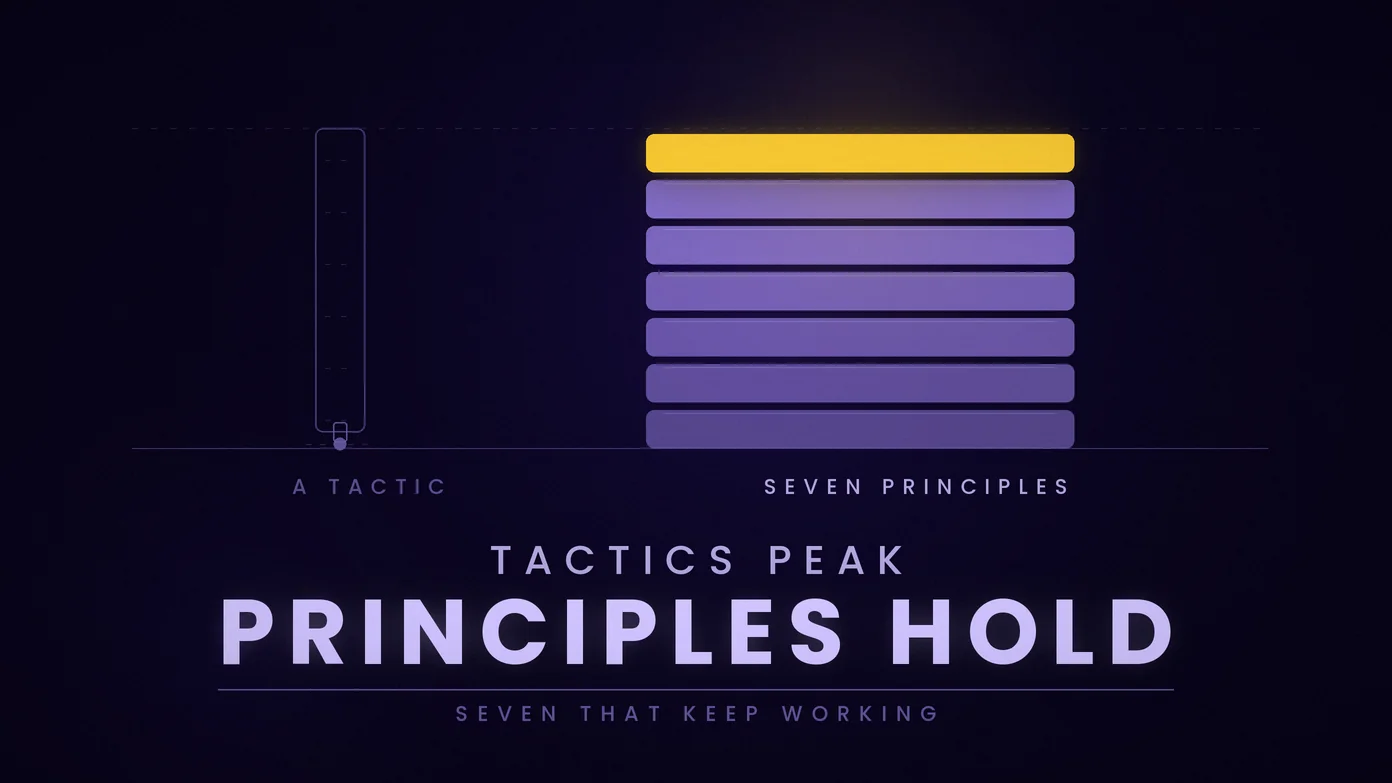
Organic social media growth is slower than the alternatives and that is the point. A tactic can lift one post. A principle keeps working after the tactic stops, after the algorithm changes, and after the trend it depended on has passed.
This guide sets out seven principles for growing an audience organically. They are not clever. Most of them are things you already know and do not do consistently, which is exactly why they still work. If you want the fast levers instead, we cover those separately in our guide to social media growth panels. This post is about the part underneath them.
The Trap: Treating Growth as a Trick
Platforms reward frequency, speed and momentum. That creates constant pressure to find the shortcut, and the shortcut usually works once. The post that goes further than the others rarely repeats, and the account that grew on a single spike often ends the quarter smaller than it started.
What survives is the part you can repeat: a content habit, a posting rhythm, a way of answering people. None of it is dramatic. All of it compounds.
The seven principles below are ordered the way most accounts need them, from what you measure to what you build. Take them in order or take the two you are weakest at.
Principle 1: Judge Growth by Engagement, Not by Follower Count
Follower counts, views and impressions rise quickly and tell you very little. Engagement rate, saves, shares, profile visits and specific comments tell you whether anyone cared.
Smaller audiences frequently outperform larger inactive ones. For partnerships and conversions, an audience of 5,000 people who interact is worth more than 50,000 who never do.
We wrote a full post on this, including what buying the wrong kind of engagement actually costs. Rather than repeat it here, read real engagement versus vanity metrics and come back. The short version: pick two engagement metrics, track them weekly beside your follower count, and let the gap between them tell you what your content is doing.
Principle 2: Publish for the Audience, Not for the Algorithm
Authentic engagement starts with content that serves the person reading it. People follow accounts that teach them something, entertain them, or solve a problem they actually have. That kind of content earns comments, shares and saves without being asked to.
- The 80/20 split: aim for roughly 80% educational, entertaining or useful content and 20% promotional.
- Answer people: reply to comments and messages consistently, not in bursts.
- Use the native format: each platform pushes its own formats hardest, whether that is Reels, carousels, short video or live.
- Write for one person: content aimed at everyone reads as content aimed at nobody.
This is the principle that makes the other six worth doing. A precise posting schedule applied to content nobody wants produces a precise record of being ignored.
Principle 3: Consistency Beats Frequency
Posting five times a week for a month and then nothing for three weeks is worse than posting twice a week forever. Audiences and ranking systems both read patterns, and an unpredictable account is harder to follow in both senses.
Pick a cadence you can hold on your worst week, not your best one. If that is two posts a week, publish two posts a week. Raise it later when the habit is boring rather than difficult.
The same logic applies to any growth service you add on top. Delivery that lands in one block is hard to measure against your own baseline, so check how a service paces delivery before you order. Our guide to spotting SMM panel scams covers the rest of that checklist.
Principle 4: Disclose Partnerships Clearly
Transparency about sponsored content builds trust.
A disclosure only works if people see it. Buried in a hashtag block at the end of a caption, it satisfies nobody.
- Put it first: a label such as #ad or #sponsored belongs near the start of the caption, not the end.
- Say it out loud: in video, mention the partnership verbally as well as on screen.
- Make it readable: text overlays in Stories and Reels need to survive a fast scroll.
- Use both: platform disclosure tools alongside your own wording, not instead of it.
Audiences are far more forgiving of a paid post they were told about than of one they discovered.
Principle 5: Protect Audience Data and Your Own Credentials
Every time you collect, store or use audience data, you take on responsibility for it. Growth tools are where that responsibility is most often handed away by accident.
Careless services scrape follower lists, gather contact details without consent, or ask for permissions they have no use for. The worst of them ask for your password.
- Never share login credentials with a third-party service. A legitimate provider needs a public URL and nothing else.
- Review app permissions on a schedule and revoke anything you no longer use.
- Read the data policy before the price list.
We go through what a provider should be able to show you, and what it should never ask for, in our post on how to find a panel worth trusting.
Principle 6: Measure the Signals Platforms Actually Read
An honest read of performance means separating the numbers that describe your account from the numbers that describe your reach.
- Engagement rate: interactions relative to followers or impressions.
- Comment quality: a specific reply is worth more than ten emoji.
- Saves and shares: the strongest signal that content was worth keeping.
- Growth against churn: steady net growth beats a spike followed by unfollows.
Watch for the inverse too: a large following with low engagement, reach with no interaction, and spikes that leave nothing behind a week later.
For what our customers order, by platform and by service, see our order data study.
Principle 7: Build a Community, Not an Audience
An audience consumes what you publish. A community shows up, argues with you, defends you, and stays when the algorithm changes its mind.
- Reply early: the first hour after posting is when a conversation either starts or does not.
- Create ways in: polls, questions, prompts, and content built from what followers sent you.
- Name people: shoutouts and featured replies cost nothing and are remembered.
- Run a recurring format: a weekly question, a series, a standing segment people can expect.
Tools can handle the mechanical numbers while you do this. They cannot do this. The point of automating the mechanical parts is to free up the time this takes.
Where Growth Services Fit
Organic growth and paid growth are not opposites, but they do different jobs. Content, cadence and community decide whether an account is worth following. A growth service can add early engagement to a post, which a new account with no audience to seed from lacks; who sees the post from there is the platform's call.
The order matters. A service applied to content that already works adds numbers to something people already respond to. Applied to content that does not, it buys a number and nothing else. That is the whole of it.
Boostero supplies engagement across 23+ platforms, shows each order's status in your dashboard, and never asks for your password. What a platform does with those signals still depends on your content, which is why this post is seven principles long and the service page is one click away.
Start With the Two You Are Worst At
Seven principles is too many to adopt at once, and adopting them at once is how people abandon all seven by Friday. Pick the two you are weakest at, run them for a month, and measure with the metrics in Principle 6 rather than with follower count.
Growth built this way is slower to arrive and much harder to lose. When you are ready to add the mechanical layer on top of it, our social media services never ask for your password, and each service states the terms that apply to it, including quality grade and refill coverage, before you order.
Frequently Asked Questions
What is organic social media growth?
Organic social media growth is audience growth earned through content, consistency and interaction rather than paid placement. It is slower than advertising and slower than growth services, and it produces the followers most likely to still be engaged a year later.
How long does organic social media growth take?
Longer than most people plan for. A consistent account usually sees engagement patterns change before follower counts do, while meaningful audience growth is measured in months. Anyone promising a specific number by a specific date is describing something other than organic growth.
Is it better to post more often or more consistently?
More consistently. A cadence you can sustain through a bad month beats a burst you abandon, because both audiences and ranking systems respond to patterns. Raise the frequency only once the current rhythm feels routine.
Can you combine organic growth with SMM panel services?
Yes, and the order decides whether it helps. Services supply the signal types platforms read when deciding distribution, and what a platform does with them is its call; they are most useful on content that already performs. Applied to weak content, they change the number and nothing else. Our guide to identifying SMM panel scams covers how to tell a careful provider from a careless one.
What metrics matter most for organic growth?
Engagement rate, saves, shares, comment quality, and net growth against churn. Follower count is context, not a result. A smaller audience that interacts is worth more in partnerships and conversions than a larger one that does not.
What are the best organic social media growth tips for 2026?
Publish for a specific person, hold a cadence you can sustain, use the format each platform is currently pushing, reply inside the first hour, and measure engagement rather than totals. Everything else on the list is a variation of one of those five.