Ask when to post on Facebook and every page has a confident answer, and the answers do not match. One large study points to Tuesday and Wednesday, from lunchtime into the evening. Another, built on more than 14 million posts, points to 9 a.m. on Thursday. Both are careful work. They disagree on the hour because they measure different things, and once you see what each one measures, the disagreement tells you something useful.
This post sets out what these two large 2026 studies agree on, where they split and why, and how to find your own hour. It ends with something no posting study can show: when Facebook engagement is actually ordered on our panel, counted from our own order records. That is a different question, and it is labelled as one.
The Short Answer
Post on weekdays, with midweek strongest. Both large studies put Wednesday at or near the top and the weekend at the bottom. On the hour they split: Sprout Social's data favours midday to evening, from noon to 8 p.m. local time on Tuesdays and Wednesdays, while Buffer's favours the morning, with 9 a.m. on Thursday its single best slot. If you have no data of your own yet, test one weekday morning slot against one weekday afternoon slot, and let your own results choose.
What the Studies Agree On: The Day
Sprout Social's 2026 analysis, built on about two billion interactions, names Tuesdays and Wednesdays as the best days to post on Facebook, with Mondays and Thursdays close behind, and puts weekends among the worst times. Buffer's analysis of more than 14 million Facebook posts published through its tool, released in February 2026, finds Wednesday the strongest day overall, followed by Thursday and Tuesday, and Saturday the weakest.
Two studies, measured differently, land on the same shape: midweek high, weekend low. Of everything said about Facebook timing, that agreement is the part to rely on.
What They Disagree On: The Hour
Sprout's best window runs from noon to 8 p.m. local time on Tuesdays and Wednesdays, with narrower windows on Mondays, from noon to 1 p.m., and on Thursdays, from noon to 2 p.m. and again at 8 p.m. Buffer's strongest results sit in the morning: 9 a.m. on Thursday is its single best time, and weekday mornings generally lead the rest of the day.
That is not a small gap. One says lunchtime into the evening; the other says breakfast.
Why Two Large Studies Give Two Hours
They answer different questions. Sprout maps when engagement happens: its heatmap shows the hours and days when interactions on Facebook are most concentrated across the profiles in its data. Buffer ranks the hour a post was published by the median engagement those posts went on to collect.
Both can be true at once. A post published at 9 a.m. does not stop collecting reactions at 10; it keeps going through the afternoon, when Sprout sees engagement peak. So "publish in the morning" and "engagement peaks in the afternoon" describe the same day from two ends. Which one matters to you depends on whether you care about the moment a post goes out or the hours it spends being seen.
Two more differences push the hours further apart. Sprout reports local time, which is right for a single brand but hides how much audiences in different countries differ. And each study describes the accounts it has: Sprout's comes from the profiles it measures, Buffer's from posts its users published, mostly businesses and creators rather than a random sample of Facebook.
How to Find Your Own Hour
Your own audience beats any study. In Meta Business Suite, the audience insights for your Page show when your followers are most often on Facebook. Pick two candidate slots from that view, one in the morning and one in the afternoon, and post comparable content in each for four weeks. Compare reach and engagement per post rather than totals, so that one strong post does not decide the test.
Change one thing at a time. If you move the hour and the format in the same week, you will not know which one made the difference.
What Timing Can and Cannot Do
Timing decides who is around when a post first appears. It does not decide whether the post is worth stopping for. A strong post at an average hour will usually beat a weak post at the best hour, so treat timing as the last adjustment, not the first.
A Different Question: When People Order Facebook Engagement, and Whether It Matters
Everything above is about when to post. This section answers something else: when people actually order Facebook engagement on Boostero, and whether the time of an order changes how it is delivered. No posting study can show this, because it comes from our own order records.
The figures come from 60,495 Facebook orders placed between January 2025 and June 2026, across every Facebook service we ran in that period, current and retired. Four large accounts that order in bulk were excluded, as in our TikTok and Instagram analyses; on Facebook they made up 8.85 percent of orders. All times are UTC, because our order records do not carry buyer country, so they were not converted to local time.
Orders follow a daily wave, and it is the same wave as TikTok
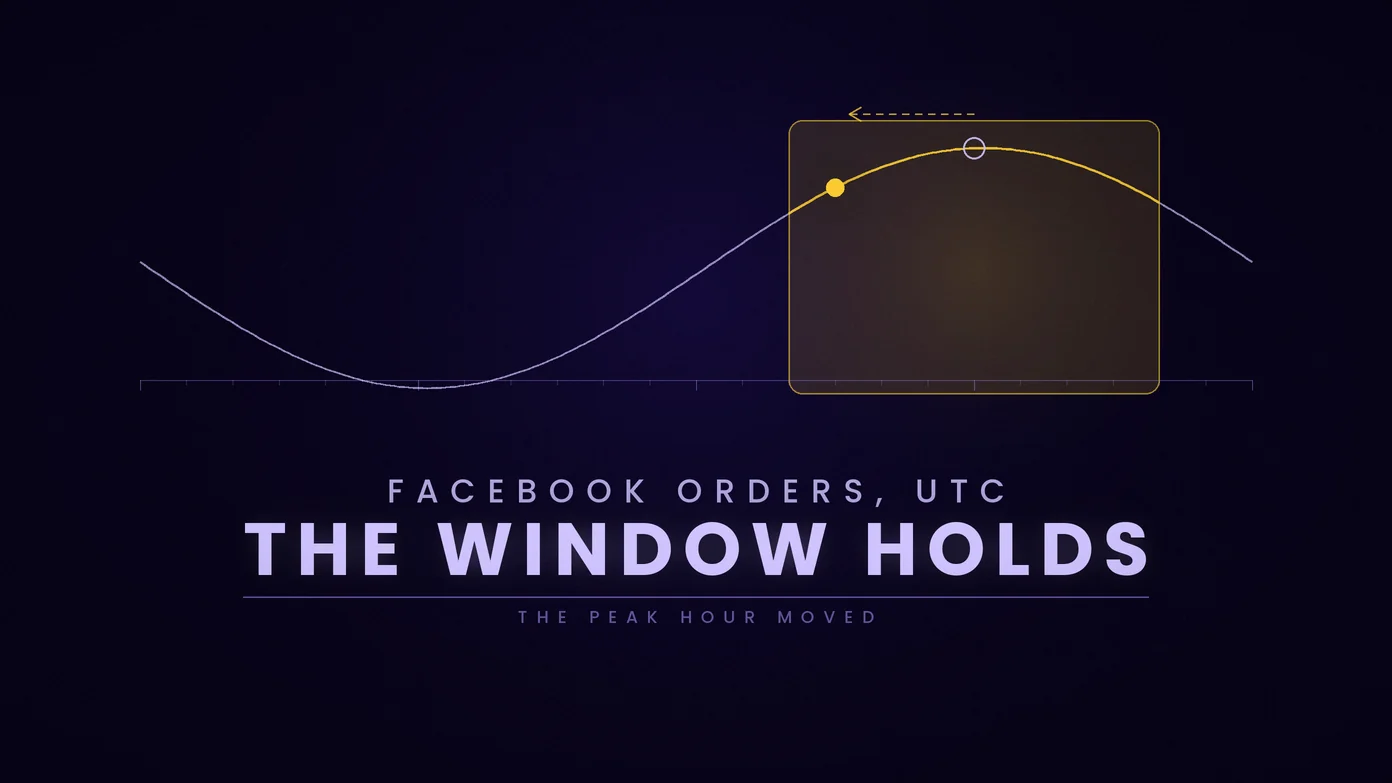
Facebook orders rise through the afternoon and stay high into the evening.
The shape is the one we found for TikTok. Compared hour by hour and counted by order, the two curves correlate at 0.79, and at 0.83 if TikTok is shifted one hour earlier. Counted by order, Facebook compared with itself, alternate days against alternate days, correlates at 0.85, so the difference between Facebook and TikTok is about as large as the noise inside Facebook alone.
The window holds; the hour moved
We checked the curve three ways: counting every order, counting each account once, and leaving out the ten largest Facebook accounts. The window from 14:00 to 22:00 UTC stays above average in all three. The single busiest hour does not hold still: counted by order, it was 18:00 UTC in 2025 and 15:00 in the first half of 2026. Counted by order, TikTok's busiest hour moved the same way over the same period, from 19:00 to 15:00, and it moved earlier under every other count we ran as well. That is why we publish the window and not the hour: a peak that moved three hours in a year, counted by order, is not a time to set a schedule by.
Delivery does not vary by hour
On TikTok, counted by order, partial deliveries were 2.5 times as common in the busiest hour as in the quietest; counted by account, the difference was too small to be sure of. On Facebook we looked for the same thing and it is not there. Counted by order, the point estimate even ran the other way, at 0.65 times the quietest hour, but once we allow for the fact that some accounts order far more than others, the range runs from 0.34 to 1.28, which includes no difference at all. Comparing days gives the same result: no measurable difference once accounts are allowed for. There is no hour or day when ordering Facebook engagement on Boostero is measurably riskier than another.
What we cannot tell you
These are orders, not posts. They show when buyers act, not when Facebook audiences are most receptive, and the buyers are a mix of brands, creators and agencies in many countries. We cannot tell you how a given order affects a post's reach, and we do not claim to.
Putting It Together
Post midweek, avoid the weekend, and test a morning slot against an afternoon slot on your own Page. If you add engagement to a post through our Facebook SMM panel, the time you order makes no measurable difference to delivery, so order when the post is ready rather than waiting for a particular hour. The services are listed by type: likes, followers, views, shares and comments.
The same questions for other platforms are answered in our guides to the best time to post on TikTok and the best time to post on Instagram.
Frequently Asked Questions
What is the best day to post on Facebook?
Midweek. Sprout Social's 2026 data names Tuesday and Wednesday as the best days, and Buffer's analysis of more than 14 million posts finds Wednesday the strongest. Both put the weekend at the bottom, with Buffer naming Saturday the weakest day.
What is the best time to post on Facebook?
The studies split. Sprout Social favours noon to 8 p.m. local time on Tuesdays and Wednesdays; Buffer's single best slot is 9 a.m. on Thursday. Test one weekday morning slot against one afternoon slot on your own Page.
Why do Facebook timing studies disagree on the hour?
They measure different things. Sprout maps when engagement happens; Buffer ranks the hour a post was published by the median engagement it collected. A morning post keeps collecting engagement into the afternoon, so both can be right.
How do I find my own best time to post on Facebook?
Use the audience insights in Meta Business Suite to see when your followers are on Facebook, pick a morning and an afternoon slot, and post comparable content in each for four weeks. Compare per-post results and change one thing at a time.
When do people order Facebook engagement?
On Boostero, Facebook orders run above average from 14:00 to 22:00 UTC, a window that held under every way we counted, across 60,495 orders from January 2025 to June 2026. Counted by order, the single busiest hour moved from 18:00 UTC in 2025 to 15:00 in the first half of 2026.
Does the time I order Facebook engagement affect delivery?
Not measurably. Partial deliveries were no more common in the busiest hour than in the quietest, and once heavy-ordering accounts are allowed for, the range includes no difference. On TikTok, counted by order, the busiest hour did carry more partial deliveries, which is why we checked Facebook separately.